To me it seems we’ve got a couple of issues that need to be spoken of.
First is a matter of translation. Idioms, in other words. Most people in our world, have an issue of thinking genius means smart about everything, including personal relationships when clearly that’s not true. You don’t have to go to college to see that, or hang out with the professors. Genii and very smart people sometimes make very stupid mistakes. We know that.
In Konoha and the Elemental Nations, genius refers to shinobi skills and not intelligence. You have genius shinobi galore, a few other genii but by and large they’re all extremely skilled for the most part. Exceptions would be where genius intellect and genius skills meet: Tobirama inventing jutsu, Orochimaru inventing/perfecting jutsu, Minato inventing/perfecting jutsu and so on.
See a trend?Please note that all these genius shinobi inventing/perfect jutsu that can, in theory be used by anyone which is why Hashirama is not on the list with his mokuton jutsu. They don’t just learn them and use them, like it is implied Sarutobi and Kakashi do. Kakashi doesn’t make the earlier list of genius intellect and genius skills because he only made one jutsu when others have made multiple.
Sarutobi and Kakashi are still considered genii. Like Sasuke and Neji are considered genii. Because of their skills. Genius shinobi skills don’t take a genius intellect, but having the latter helps.
Which means that Konoha has a pointed problem of application of seeing/using genius outside of warfare and skills applicable to war. As does its people.
Next Point:
Even if they don’t admit it, they -everyone in the Elemental Nations- are always focused on war. It’s why Jiraiya and later Naruto are such oddballs because they want to focus on PEACE by NON-VIOLENT METHODS.
Politically speaking, they are politically always at the precipice of war, even during ‘peace’. It doesn’t mean that tragedy/death/trauma doesn’t happen then. It just means that it wasn’t enough to start a war.
Having the Jinchuriki actually does help as a deterrent; they either keep the ‘war(s)’ small-scale and ‘cold’ in that should shinobi here be near shinobi from other place, they’re likely going to try and kill each other without leaving clues to who did it. If they did or were caught at doing so, then war may actually break out.
Point the third:
War happens for a two reasons: resources and ideology.
Resources can be food, people, skilled professionals aka blacksmiths/whatever, water, minerals etc.
Ideology could be for religion, belief that things should be done differently or that this person should rule. Or because you really hate this bastard/group because they killed your brother.
A lot of the Warring Clan Era’s ‘Wars’ happened because of shinobi ideology and personal reasons.
The 4th point:
‘Wars’ during the Warring Clan Era mostly happened between shinobi clans. Most shinobi clans are skilled at being shinobi which makes them very avid consumers to any market. They need weapons, clothing, food etc.
Unless they live in Kaze no Kuni, where resources are at a premium. But that’s a different story.
Which because most of the shinobi aren’t fighting over food, means that they’re fighting for shinobi reasons aka their client, for the money, etc. Because they need money.
The reason the feud between the Senju and Uchiha became so big and infamous because those fights turned from professional to personal over generations. To the point that I wouldn’t be surprised if a few shinobi decided that not getting paid was worth the risk to try and kill a few Senju/Uchiha.
5th Point:
Villages are a new concept, not even a century old. There’s immense changes politically and economically and so on. And generations are a thing.
Generational Mindsets are a thing. Values passed down and so on. See baby-boomers vs Millenials and so on.
So really, you don’t have to look far to see that establishment of shinobi villages changes things. A lot of things, especially for those old enough to remember the village not being there. Which is pretty much anyone older than the young Sandaime, when he was the Nidaime’s student. As Sarutobi was about ten when Konoha was founded, that’s a lot of people.
The first generation born in the village is something I’m going to call Hopes and Dreams. Because that’s what their parents hoped for and so on. We really don’t much about them, being younger than Danzo, Sarutobi and so on but older than the Sanin. They’re just kinda there?
The point being, these were probably the first generation of shinobi to have a stable home-life during their childhood. Not constantly moving around from base to base, camp to camp worried about safety constantly. They were probably trained like their parents were, but due to being more sheltered from war aka not seeing it from the time they were born/walking, they were a bit more traumatized by it. H&D had parents transitioning from shinobi soldiers to parent-trainers/teachers because they had no idea how to parent that didn’t involve teaching them to survive war: because the village was a safe place, so long as people would defend it.
And they would, because they were shinobi.
*
The next generation tags along after this, which is what I’m going to call the genii-boom. Because there were a lot of strong shinobi/genii and most of them went down in a boom of self-destructive habits. Often messily.
Hatake Sakumo is a member of this generation. The Sanin are too. Their parents are either Clan War survivors or part of H&Ds. Which has effects, okay? Sakumo’s parents were probably Clan War Survivors and very much converts to the idea of Konoha, since the idea to avoid war at the cost of comrades apparently did not ever enter his mind. Very admirable on a personal level, very stupid on a political level. Tsunade and Orochimaru’s parents were probably CWS too who may have died in the 1st great shinobi war or shortly after. Jiraya has no parents mentioned, so he doesn’t get the CWS mindset from his parents. Instead, Jiraiya is very much a H&D-child; lots of optimism, still train just in case.
As you can see, because the concept of Village is new-ish, the concept of thinking outside personal politics is also a new thing. Village Reputation now exists and is shown by its shinobi. Which is why Sakumo is reviled by his peers because as a genius shouldn’t he know how his actions effect the village? The fact Sakumo chose to atone for this personally by suicide instead of by other means also speaks to him thinking like a CWS instead of a member of Konoha. The fact that it orphans Kakashi and he doesn’t think it will really matter as Kakashi is a brilliant shinobi already speaks more about this.
The Sanin were pretty much the stars of this generation btw. We also know how this all went. This is when trauma really starts to get noticeably worse, to the point of phobias. Because they’re not used to friends/family/comrades dying in droves like CWS are. War becomes very abhorrent to most of them.
This marks a shift in politics here, at least for Konoha.
They want to try to avoid war.
This is probably when the idea of the Chunin exams came to be.
*
Now the next gen, I will say is the Parent Generation. These are the parents of the majority of Naruto’s cohort in academy and as ninja peers.
Their parents fought in the 2nd Great Ninja War, while they were young. Like, no, daddy’s not here because he’s on the front lines and momma’s been injured real bad so she can’t be a shinobi anymore.
They grew up in war-time, if not at war. There was a break for about a decade and then came the 3rd Great Shinobi War, which they fought in as teens and young adults.
This results in a sort of mental dichotomy. You have parents being loving parents, yet also very capable killers. Most of those shone here are remarkably mentally stable, caring to friends, killers to enemies.
Although nothing really explains the Yondaime’s actions to Naruto except him being a village leader and securing power in Konoha for a future generation. It’s nice that you believe in him, but that is not how you fatherhood.
*
The next generation is the Sensei-generation, being about a decade younger than the Parent Generation.
Raised in war-time, fought in war as young teenagers. Comrades dying and so on. Very terrible, very traumatic.
Itachi catches the tail-end of this generation, severely traumatized by the one battlefield he saw. To the point he doesn’t want war but wants to dedicate his life to that of pacifism. Itachi makes no sense, really.
Also, Kabuto also is here. As a baby, but he’s here.
*
The next generation is the Kyuubi-generation, being mostly made of Naruto’s peers and a little older. They grew up in peace, and the first death they experienced personal loss for was Asuma’s, followed by Neji’s sacrifice.
Any other death related to enemy-shinobi so that was just business. Even then, they seem remarkably hesitant to kill? Except Sasuke and Gaara.
No one is denying that they’re talented but they’re very soft and underprepared for actual war and death. Like Gaara killing in the Forest of Death freaked Team 8 out a lot.
Sixth Point:
Villages are new. Village politics are new.
Sandaime had two examples to look up to on how to rule Konoha. The Shodai, and Nidaime.
I get the feeling that the Shodai wasn’t much of a policy maker/ruler? Like here, I make village. Laws um… ask my brother.
Now the Nidaime, being a genius can actually apply his genius intellect to ruling. Like bureaucracy, fear him. He probably set up all sorts of regulations, laws and so on. We know he had a hand in creating the Konoha Military Police, he probably created AnBu too.
When the Sandaime took office, both of them were also very dead.
So Sarutobi ends up working international politics, village politics and so on without a mentor or much of a clue to go on. Just saying that Sarutobi earned his Hokage hat in war, finished the war, while trying to figure out how to Hokage. He then raised his students, got married and had kids, and so on while trying to Hokage and parent at the same time, which was more difficult seeing as how Asuma ran to the Daimyo-Guard and his sibling is never mentioned?
Sarutobi also has to deal with the generational shifts and the mindset in his shinobi. Don’t want war?
I’ll see if I can avoid it. Would you be willing to sacrifice one of your members Hyuuga-clan? Thank you. War averted.
See the think about Sarutobi is that he adapted his mindset for when there’s peace vs when there’s war. He became a parent who could be a loving father and a God of Shinobi.
Danzo didn’t. Danzo is still very much a CWS. Survivors don’t make good rulers. They’re too busy working on surviving to rule in any long-term feasible way.
Point Seven:
When you write a Naruto character please pay attention to their world and what it means to them/how it has effected them.
This means generational mind-sets, the history of the world, the ideology of shinobi and how closely a character adheres to that.
I have my issues with the manga and anime itself, but these are the issues I have with fandom. Kishi’s rather terrible with strong female leads but he was very good at showing how generations, history and parents -or lack of- shaped his characters.
Both good and bad.
What say you @blackkatmagic and @hiruma-musouka
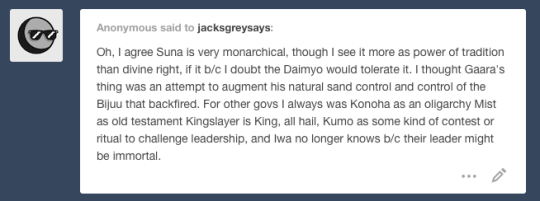
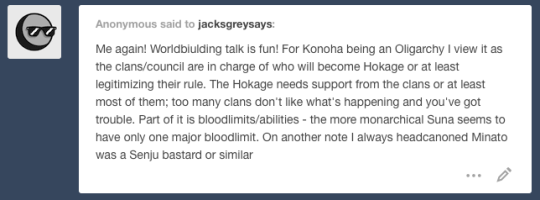
@jacksgreysays what do you think?
This is a fantastic read (thanks for tagging me, @book14reader) and I agree with most everything here. There are some clear generational differences in Naruto that do affect characterizations, cross-generational relationships, as well as the reader’s consumption of the manga. There are a few tangents (not arguments because they’re not against what @insanescriptist said, so much as just… sideways) that struck me as I was reading this:
1) clan vs “civilian” shinobi
I’m not sure if this is implied, but the generation midsets that insanescriptist describes best works with clan kids or those who have shinobi parents and become shinobi themselves. It’s not quite analogous to university education or immigration status, but there is this sense of being the first shinobi in the family (or being an orphan and becoming a shinobi) influences how children learn about what it is to be a ninja and how that relates to the village:
Take the Kyuubi-generation: of the Rookie Nine, only Team Seven aren’t part of active shinobi clans with Naruto being an orphan, Sakura being civilian born (… if we’re going by manga instead of anime and even then, they aren’t clan shinobi), and Sasuke having lost his clan at around age seven. Some of Team Eight and Ten are even clan heirs/children of the clan heads!
What this means is that, given their familial duties, the other Rookie Nine are raised to be aware of if not their actions reflecting the entire village, then their respective clans at the very least. Team Seven? Doesn’t really have that. Oh, sure, Sasuke keeps in mind an idealized version of what the Uchiha clan would want, but he doesn’t actually know; he lost them too early to get a real idea of that. Sakura has no clan connections, which means it’s only her teammates/sensei which connects her to the idea of the ninja side of the village–a somewhat mellower version of Naruto’s precious people schtick.
Which partially explains why Team Seven’s team melodrama is literally effecting things like foreign relations–each of them think so much of themselves as individuals that they don’t even bother with how this might look like to the rest of the world. Sasuke never being declared a missing nin and the “kidnapping” Killer B? HOW COULD THIS POSSIBLY GO WRONG?! Oh, Naruto will just talk to the Kumo team so they won’t declare war on Konoha/demand Sasuke’s head–no biggie. Team Seven doesn’t understand the political ramifications of their actions–well, maybe Sakura, only because her shishou is the Hokage–and it has to do with them not being clan kids, not being raised entrenched in this system of group over individual.
Extend that to the other generations–of the genii-boom (Hatake Sakumo and the Sannin) only Tsunade is part of a clan, while Orochimaru is a confirmed orphan and Sakumo and Jiraiya’s parentage is kind of unsure. Orochimaru leaving the village (I mean, despite the whole “crimes against humanity”) means he actually full on left the village–missing nin status, creating a rival village, eventually coming back to kill the Sandaime. It’s a very individualistic take on being a shinobi.
Contrast with Tsunade who–even though her clan is basically now herself, she was raised with the name and the responsibilities–though she leaves, never becomes a liability to Konoha. She never acts against the village. In fact, she comes back when asked to (and sure it took a pathos based argument from Naruto) and becomes the Hokage. Not only is that a point for her motivations–that she never had anything against the village per se–but also for her reputation: even decades of “retirement” couldn’t diminish her power when she stepped into office.
An invasion and recently killed Hokage should have made Konoha prime prey for the other villages–in particular Kumo and Iwa, given their previous historic grudges against Konoha. There should have been a following invasion, especially at that point in time when Killer B and Yugito were so much better trained than Konoha’s singular jinchuuriki.
But I digress.
While I don’t really know what the Hatake family was like or who even Jiraiya’s parents are, I think it’s safe to assume that they probably weren’t from clans or not very big clans at least. So Sakumo failing a mission to save his friends? Makes sense if he’s not a clan kid–he doesn’t have that bigger picture trained into him, his version of the village is through the people he knows (ie his teammates… is this just fanon or canon, but the teammates on that mission were they his genin teammates?).
And Jiraiya? He was asked to be Hokage first before he passed the buck to Tsunade–he rejected even though the village needed a strong shinobi in power ASAP. And, yes, you can argue that he’s head of the spy network, etc, etc, he serves Konoha by being out in the field and anyway it’s time to bring Tsunade back into the fold. Yes. But there’s nothing to say that he couldn’t have delegated his spy network to someone else–or assigned someone else to get Tsunade while he played interim Hokage. No, he was still being too butthurt about the Sandaime preferring Orochimaru over him to step up.
—
2) de-escalation of Kages as killers
I don’t even know where I’m going with this, but I think it’s super neat how (ate least with Suna, Konoha, and Mizu) that the Godaime are all known for not being killers? Because Tsunade is most famous for being a revolutionary medic nin, Terumi Mei for being a politician, and while Gaara is known for being a killer it’s only when he became less homicidal that he became Kazekage.
I mean, sure, it’s not like there were many other choices (given the whole weird Kazekage bloodline thing) but I feel like if Gaara had stayed that crazy loose-cannon, regardless of how powerful he is, they would have gone with Temari as Kazekage with Gaara as her barely leashed weapon of mass destruction. (Though having three out of the five major villages have female rulers would have been super cool).
Then Naruto is basically ninja messiah espousing “peace via non-violent methods” so it’s still following that trend even if he is literally the strongest being in the world.
—
3) Kyuubi-generation is not our generation
Unfortunately? I feel like this is something that didn’t become obvious to me until afterwards because it felt like they should be. They grew up alongside me the reader, so it felt they should be. And there was such a dissonance during the epilogue–similar to, but not as strong as the epilogue for the Harry Potter series–like, an almost disappointment that everyone just paired up and had children and maintained the status quo. With Harry Potter, it was especially disappointing because there are years that match up to the real world and so we know how old everyone would be right this very second if it were real. Naruto series, not so much.
The Kyuubi-generation, despite all their radicalism in their youth, are mostly just perpetuating what they know. Traditionalism of the village lifestyle they grew up in being passed down to their children because, hey, they grew up in peace and maybe we shouldn’t rock the boat. But you know what? They’re still being trained as warriors even though it’s supposed to be world-wide peace. If this really were a successful peacetime, their kids wouldn’t be trained with weapons they’d be trained for healing (always can use more doctors) or sealing or other nonviolent ways to apply chakra. We’ve seen that this is possible–the Fire Temple has monks who don’t use chakra for offensive abilities–but Naruto doesn’t make that change. And, yes, maybe it’s because he doesn’t know how. For all that he is ninja messiah he was raised as a weapon alongside all the other Rookie Nine/Konoha Twelve.
(Also, the women are keeping house and the men are out at work and I hope to god this is not how my generation turns out. Wth, this is some Stepford Wives bullshit).


 JackSGreyson Says